Heavy-Duty PTO Drive Shafts for Rotary Tillers
Engineered for extreme torque transmission in agricultural soil preparation. Maximum power transfer, integrated safety clutches, and robust construction to conquer the toughest terrain conditions.
Core Power System Selection Guide
When configuring a rotary tiller implement, the power take-off (PTO) driveline serves as the critical mechanical artery between the tractor’s output spline and the implement’s input gearbox. The precise matching of torque rating, working angle limits, and overload protection mechanisms directly dictates field uptime. EVER-POWER designs focus on multi-lip sealing, dynamic balancing up to 1000 RPM, and integrated friction slip clutches to mitigate shock loads from rock strikes or heavy clay binding.
- ✔
High-Yield Forged Yokes: Manufactured using 1045 high-carbon steel, heat-treated for superior fatigue resistance against continuous torsional vibration. - ✔
Advanced CV Joint Geometry: Constant Velocity wide-angle configurations allow up to 80-degree turning angles without power interruption or destructive chatter. - ✔
Telescoping Profile Optimization: Options include Italian-style triangular tubes or German-style lemon profiles, coated with anti-galling compounds for seamless telescopic action under full load. - ✔
Intelligent Overload Protection: Pre-calibrated slip clutches with sintered bronze friction discs eliminate shear bolt replacement downtime in rocky paddocks. - ✔
Absolute Safety Shielding: UV-resistant, impact-tested master shields and safety chains comply strictly with international safety protocols.
Engineering Dynamics: Rotary Tiller Power Transmission
The functional demand placed on a PTO shaft driving a rotary tiller is among the most severe in the agricultural sector. Unlike mowers or balers, a rotary tiller constantly battles subterranean obstacles, varying soil densities, and aggressive root systems. This continuous shifting of load creates microscopic torsional spikes.
Our drivelines establish the primary mechanical link connecting the 540 or 1000 RPM tractor output to the implement’s central gearbox. Through the precision-machined universal joints (U-joints), rotational force is seamlessly transferred even as the 3-point linkage raises and lowers the tiller over uneven ground. The telescoping action of the inner and outer tubing compensates for the changing distance between the tractor and the implement.
To protect both the tractor’s internal transmission components and the implement’s driveline, an integrated Friction Slip Clutch is mounted on the implement side. When the tiller tines strike an immovable object (such as a large subterranean rock), the torque requirement instantly exceeds the transmission capacity. Instead of shearing a metal bolt or shattering gear teeth, the internal friction plates slip, safely dissipating the kinetic energy as heat until the obstruction is cleared.
Technical Parameter Matrix
| پیرامیٹر | Specification / Customization Range | Engineering Significance |
|---|---|---|
| Tractor Power Range | 25 HP to 250 HP | Determines series sizing (Series 1 through Series 8/9). |
| Dynamic Torque Capacity | 460 Nm – 3800 Nm | Continuous operational torque without metal fatigue. |
| Peak Torque Limit | 750 Nm – 6500 Nm | Absolute maximum load before safety clutch activation. |
| Input Spline Interface | 1-3/8″ 6-spline, 1-3/8″ 21-spline, 1-3/4″ 20-spline | Standard tractor PTO stub compatibility. |
| Operating RPM | 540 RPM / 1000 RPM | Calibrated for U-joint bearing life and tube balancing. |
| U-Joint Cross Dimensions | 22x54mm, 27×74.6mm, 30.2x92mm, 35×106.5mm | Direct correlation to load-bearing needle roller capacity. |
| Telescopic Tube Profile | Triangular, Lemon, Star, Involute Spline | Dictates sliding friction and torsional rigidity. |
| Closed Center-to-Center Length | 600mm – 2000mm (Customizable) | Base length measurement when fully compressed. |
| Maximum Extended Length | Up to 3000mm | Ensures 1/3 minimum tube overlap is maintained. |
| Yoke Material Grade | Forged C45 / S45C High Carbon Steel | Prevents fracture under shock load conditions. |
| Cross Journal Heat Treatment | Carburized and induction hardened (HRC 58-62) | Maximizes surface wear resistance while retaining core ductility. |
| Overload Safety Device | Friction Slip Clutch (2-disc or 4-disc), Shear Bolt | Essential for rotary tillers to prevent driveline destruction. |
| کنکشن کو نافذ کریں۔ | Plain bore with keyway, Tapered pin, Splined yoke | Matching the tiller gearbox input shaft configuration. |
| Standard Working Angle | Up to 25 degrees (Continuous) | Optimal angle for standard single U-joints. |
| Maximum Articulation Angle | 45° (Standard) / 80° (Wide Angle CV) | Critical during sharp headland turns. |
| Safety Shielding System | Free-spinning plastic cones with retention chains | Mandatory for operator protection; prevents entanglement. |
| Shield UV Resistance | Grade 5 Polymer Additives | Prevents plastic degradation in high UV environments. |
| Lubrication Interval | Every 50 hours (Standard) / 250 hours (Extended Life) | Based on EP2 Lithium complex grease application. |
| Dynamic Balancing Quality | G6.3 or G16 (ISO 1940 standard) | Eliminates resonance vibrations at high RPMs. |
| Surface Anti-Corrosion | Electro-phoretic deposition / Powder Coating | Provides >500 hours salt spray resistance. |
| Bearing Seal Type | Triple-lip NBR elastomeric seals | Excludes fine dust, mud, and agricultural chemicals. |
| Inner Tube Hardness | HV 210-250 | Optimized for wear resistance against telescoping friction. |
| Clutch Disc Material | Asbestos-free organic composite / Sintered Bronze | High thermal threshold during prolonged slip events. |
| Spring Tension Calibration | Adjustable via coil spring compression lengths | Allows fine-tuning of slip torque to match implement age. |
| Tractor End Fastening | Quick-Disconnect (Push Pin / Slide Collar) | Enables rapid attachment to the tractor spline without tools. |
Performance Supremacy: Engineered to Outlast
The global agricultural market is flooded with substandard power transmission components that prioritize low initial cost over metallurgical integrity. When deploying a rotary tiller, the driveline absorbs extreme stress. Inferior shafts utilize cast yokes and single-lip seals. Under the harsh realities of tillage, these cast yokes micro-fracture, and cheap seals allow silica dust to contaminate the needle bearings, resulting in catastrophic cross-journal failure within a single season.
EVER-POWER adopts a no-compromise manufacturing philosophy. Our yokes are drop-forged, creating a continuous grain flow in the steel that multiplies yield strength. Our universal joint crosses utilize triple-lip nitrile rubber seals, effectively locking out aggressive soil particles. Furthermore, the telescopic tubes undergo a proprietary extrusion process that ensures minimal tolerance gaps, drastically reducing lateral whip and vibration at 1000 RPM. This results in a component that not only extends maintenance intervals but actively protects your tractor’s transmission from shock-induced damage.
Brand Compatibility & Interchangeability
Upgrading or replacing existing drivelines does not require replacing the entire machine. Our engineering dimensions meticulously align with global standards, ensuring seamless integration with existing agricultural fleets.
Note: All manufacturer names, numbers, symbols, and descriptions are used for reference purposes only, and it is not implied that any part listed is the product of these manufacturers. EVER-POWER operates as an independent, premium engineering manufacturer.”
Australia & Oceania Extreme Terrain Field Study
Navigating the strict AS 1121.4-2007 safety standards and combating the harshest soil conditions in the Southern Hemisphere requires uncompromising engineering data.
Regulatory Compliance: Safe Work Australia
Australian states strictly enforce the guarding of power take-offs. Any machinery operating in NSW, Victoria, or Queensland must feature an integral shield capable of rotating independently from the central shaft. EVER-POWER guards utilize ultra-violet stabilized polymers, preventing the cracking and embrittlement commonly seen under the fierce Australian sun, maintaining full WorkSafe compliance.
Queensland: The Black Soil Challenge
In the Darling Downs, vertosol (black clay) expansion places immense static load on rotary tillers. Traditional shear bolts fail hourly in these sticky conditions. Implementing our 4-disc Friction Slip Clutch allowed continuous operation, slipping only during peak binds and automatically re-engaging once the clay clot cleared the tines.
Western Australia: Abrasive Silica Ingress
The sandy loams of the WA Wheatbelt act as an aggressive grinding paste on moving components. Standard U-joint seals fail rapidly. Our engineering response was the integration of a multi-lip labyrinth seal design, packing the journal with extreme-pressure lithium grease, extending the bearing lifespan by over 300% in field trials near Perth.
Engineer’s Field Notes: Global Reliability Cases
Case 01: Vineyard Headland Turns (South Australia)
Barossa Valley, AU
Client Pain Point: “Tractor operators were constantly having to disengage the PTO during tight headland turns at the end of vine rows. If they forgot, the standard U-joints would bind, chatter, and eventually shatter the implement gearbox input shaft.”
EVER-POWER Solution: Deployed a Series 6 Wide-Angle Constant Velocity (CV) joint on the tractor side. This allowed articulation up to 80 degrees under full power without U-joint velocity fluctuation.
Result: Operational speed increased by 18%, and driveline vibration during cornering was completely eliminated.
Case 02: High-Moisture Rice Paddy Tillage (New South Wales)
Riverina Region, AU
Client Pain Point: “Water and mud ingress was destroying the sliding profile tubes. The tubes would rust together overnight, making it impossible to attach the rotary tiller to the tractor the next morning without sledgehammer force.”
EVER-POWER Solution: Upgraded the client to Rilsan® coated internal spline tubes with enhanced greasing zerk positioning. The polymer coating creates a zero-rust sliding boundary layer.
Result: Zero binding issues over three continuous planting seasons. Lubrication time cut in half.
Case 03: Macadamia Orchard Sub-Soil Obstructions (Queensland)
Bundaberg, AU
Client Pain Point: “Using heavy 3-meter rotary tillers to mulch prunings, operators frequently hit hidden volcanic rocks. Shear bolts were snapping 5 times a day, costing immense labor downtime.”
EVER-POWER Solution: Replaced the shear bolt yokes with a heavy-duty 4-pad friction slip clutch, factory-torqued to slip at exactly 2200 Nm—just below the gearbox failure threshold.
Result: “We haven’t changed a pin in 12 months. The clutch smokes a bit when we hit a boulder, the driver lifts the linkage, and keeps going. Massive ROI.”
Case 04: Continuous Commercial Contracting (Victoria)
Gippsland, AU
Client Pain Point: “As a contractor running 250HP tractors on massive folding tillers, the sheer torque twists standard lemon-profile tubes, causing terrible vibration in the cab.”
EVER-POWER Solution: Implemented star-profile heavily reinforced sliding tubes and precision dynamic balancing (Grade G16). Star profiles offer significantly higher contact surface area for torque transfer compared to traditional shapes.
Result: “The cab is silent at 1000 PTO RPM. The power delivery is incredibly smooth.”
Case 05: Mountain Terrain Pasture Renewal (New Zealand)
Canterbury, NZ
Client Pain Point: “Tilling on steep gradients creates high angles on the driveline. Combined with the heavy rotor inertia of the tiller, stopping the tractor was dangerous because the tiller kept pushing the tractor forward via the PTO.”
EVER-POWER Solution: Integrated a combined Overrunning Clutch + Friction Slip Clutch. The overrunning clutch free-wheels when tractor RPM drops, allowing the tiller to spin down naturally without transferring kinetic energy back to the transmission.
Result: Tractor braking stability on hillsides restored perfectly, eliminating a critical safety hazard.
Rapid Sizing & Selection Guide
Identifying the exact specifications prevents premature failure and ensures operator safety. Follow this engineering matrix to select the appropriate power transmission component for your rotary tiller.
| Step | Evaluation Criteria | Measurement Method / Engineering Note | Recommended Action |
|---|---|---|---|
| 1. Power Rating | Tractor PTO HP & RPM | Check tractor manual. 540 RPM is standard for small tillers; 1000 RPM for 150HP+ commercial tillers. | Match shaft Series (e.g., Series 4 for ~35-50 HP, Series 6 for ~60-90 HP). |
| 2. Geometry | Closed Length Dimension | Measure distance from tractor output shaft groove to implement input shaft groove with the tiller raised to be perfectly level with the tractor shaft (the shortest distance). | Select a shaft slightly longer. You will need to physically cut the tubes to exact size to ensure 1-inch clearance at maximum compression. |
| 3. Connections | Tractor & Implement Splines | Count splines and measure outside diameter. Common is 1-3/8″ x 6 spline. Tillers often have a plain bore with shear pin, or a splined input. | Specify Yoke A (Tractor) and Yoke B (Implement). E.g., Push-pin spline to Friction Clutch. |
| 4. Safety Phase | Implement Type Assessment | Rotary tillers encounter severe shock loads. Mowers encounter inertia. | Always specify a Slip Clutch (Friction type) on the implement end for rotary tillers. |
Precision Installation Protocol: Cutting the Tubes
- Connect the implement to the 3-point linkage but do not attach the driveline.
- Raise or lower the implement until the tractor shaft and implement shaft are perfectly horizontal to each other (this is the shortest possible distance).
- Hold the two halves of the driveline parallel to each other. Mark the overlapping sections.
- Cut the exact same amount off both the inner and outer steel tubes, and their corresponding plastic shields.
- Deburr the edges meticulously. Apply EP grease before reassembly. Ensure at least 1/3 of the tube length remains overlapped at the maximum operating extension.
Troubleshooting Diagnostics & Maintenance
⚠ Intense Vibration During Operation
Diagnosis: U-joints are out of phase, tube profiles are twisted, or working angle exceeds 25 degrees on standard joints.
Correction: Disconnect the two halves. Ensure the yokes on both ends of the shaft are perfectly aligned (in-phase). Check for bent tubes. Reduce 3-point linkage height to normalize working angles.
⚠ Slip Clutch Smoking / Constant Slipping
Diagnosis: Tiller is set too deep in hard soil, spring tension is too loose, or friction plates have worn down to metal.
Correction: Raise the tillage depth. Measure the spring compression length with calipers according to the manual and tighten evenly. If discs are glazed or below minimum thickness (typically 2.5mm), replace discs.
⚠ Cross Journal Bearings Running Hot / Squealing
Diagnosis: Lack of lubrication, ruptured seals allowing dirt ingress, or needle rollers have pulverized.
Correction: Pump EP2 lithium grease into the zerk until it purges from all four seals. If the cross kit shows any radial play (looseness) or feels gritty when manipulated by hand, replace the entire cross kit immediately to prevent yoke destruction.
⚠ Telescopic Tubes Binding (Will Not Slide)
Diagnosis: Lack of grease on profiles, galling of steel, or a slightly bent tube from the implement dropping too fast.
Correction: Pull halves apart. Clean thoroughly with solvent. Inspect for galling (metal scraping). File high spots gently. Apply heavy graphite grease. If tubes are visibly bowed, the entire shaft assembly must be replaced to prevent transmission damage.
Comprehensive Power Transformation: The Agricultural Gearbox Synergy
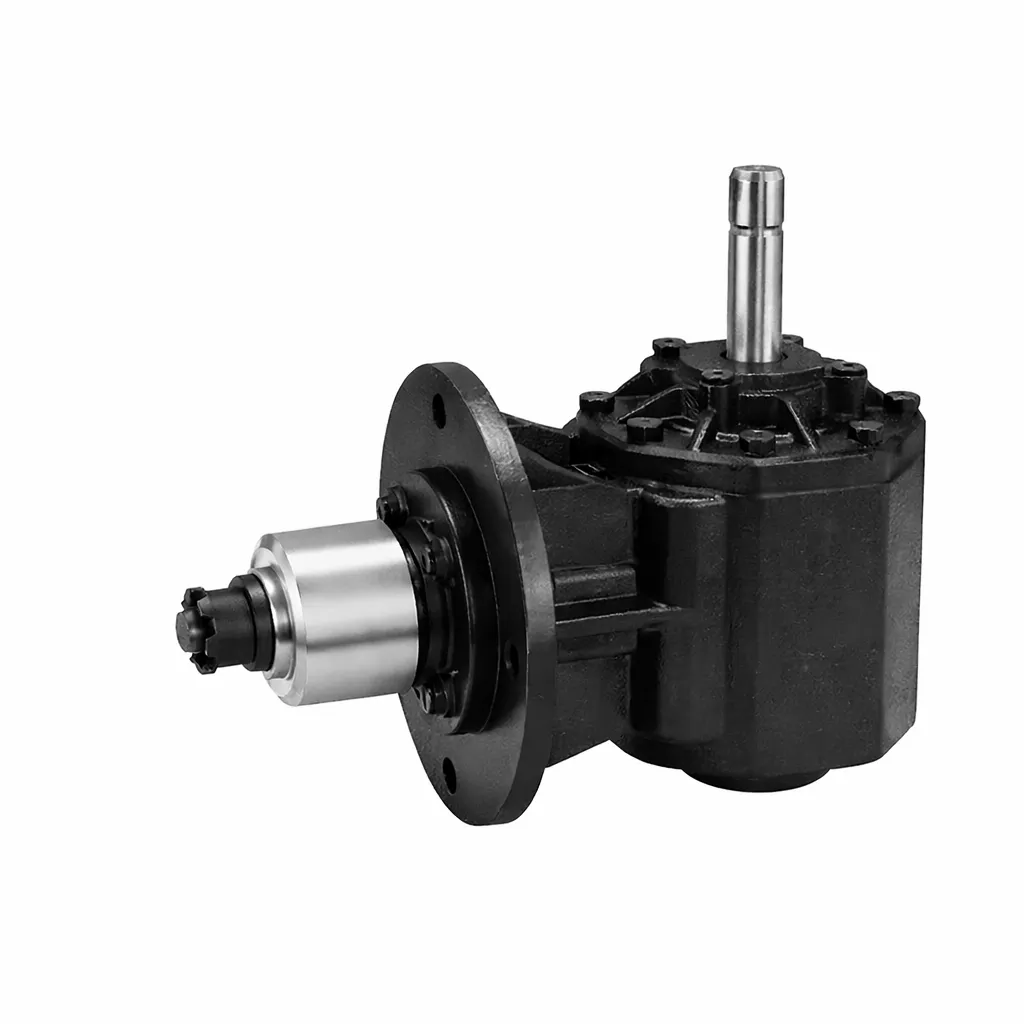
A PTO driveline is only half of the mechanical equation. Without a high-integrity agricultural gearbox to receive, redirect, and amplify the torsional energy, the rotary tiller cannot function. At EVER-POWER, we manufacture the complete powertrain.
The Critical Transition Point
When the kinetic energy travels from the tractor output, through the universal joints, down the telescoping tubes, and past the friction slip clutch, it arrives at the input spline of the rotary tiller’s central gearbox. This interface is where raw rotational speed is transformed into brutal digging torque. In a standard rotary tiller setup, the input RPM of 540 is often reduced to a rotor shaft speed of 200 to 250 RPM. This reduction in speed results in a proportional magnification of torque, allowing the steel tines to fracture compacted topsoil, slice through root networks, and incorporate crop residue into the earth.
Our agricultural gearboxes are cast from high-density nodular iron (ductile iron), selected specifically for its superior shock absorption capabilities compared to standard gray cast iron. When a tiller blade strikes a piece of buried bedrock, a massive shockwave travels up the rotor axis, into the side gear or chain drive, and ultimately hits the central gearbox. If the housing is brittle, it fractures, bleeding GL-5 gear oil into the soil. Nodular iron flexes microscopically, absorbing the acoustic and kinetic shockwave.
Internal Metallurgy: Bevel Gears and Pinions
Inside the rugged cast housing lies a set of precision-cut spiral bevel gears. Unlike straight-cut gears that whine under load and have localized stress concentration, spiral bevel gears offer a sweeping contact patch. Multiple teeth are engaged simultaneously. To manufacture these gears, we utilize advanced Gleason gear cutting machinery, ensuring involute profiles that mate flawlessly. Following the cutting process, the gears undergo a rigorous carburizing heat treatment. They are baked in a carbon-rich atmosphere, which infuses carbon into the outer millimeters of the steel. The result is a gear tooth with a glass-hard surface (resisting friction wear) but a softer, ductile core (resisting impact shattering).
The bearing architecture within our gearboxes utilizes oversized tapered roller bearings. These bearings are designed to handle both radial loads (the force pushing sideways against the shaft) and axial thrust loads (the force trying to push the shaft out of the box). During assembly, engineers meticulously adjust the bearing pre-load using precision shims, removing end-play to zero-tolerance specifications. This rigid alignment guarantees that the gear mesh pattern remains perfect, even when transmitting over 100 horsepower.

Lubrication Dynamics and Thermal Management
Heat is the enemy of mechanical efficiency. As the gears mesh and drive heavy loads, friction generates intense heat. This heat causes internal air to expand, building pressure inside the sealed housing. Our gearboxes feature strategically placed breather valves that allow hot air to escape while utilizing internal baffling to prevent oil aerosol from blowing out. We strictly recommend extreme pressure API GL-5 80W-90 or 85W-140 gear lubricants. The sulfur-phosphorus additives in GL-5 oil form a sacrificial chemical film on the gear teeth, preventing metal-to-metal welding under extreme pressure spikes.
Power Distribution: Side Drives
Once the central gearbox redirects the power 90 degrees, it travels outward via cross shafts to the implement’s side-drive mechanism. In light-duty tillers, this is typically a heavy-duty roller chain operating in an oil bath. For heavy-duty, commercial rotary tillers, power is transferred via a cascading gear drive (gear-driven side). The cascade gear system eliminates the stretching and snapping associated with drive chains, ensuring that timing and torque remain absolute.
Matching the PTO series to the agricultural gearbox capacity is paramount. Supplying a 150HP gearbox with a Series 4 driveline guarantees driveline destruction. Conversely, supplying a 40HP gearbox with a Series 8 driveline without a properly calibrated slip clutch will result in the gearbox exploding if the tiller hits a rock, because the massive driveline will not yield. Our engineering support team ensures the mathematical harmony between the tractor output, the PTO driveline rating, the clutch slip threshold, and the gearbox input maximum torque.
Related Accessories & Wear Parts
Maintain peak operational efficiency with our OEM-certified replacement components.
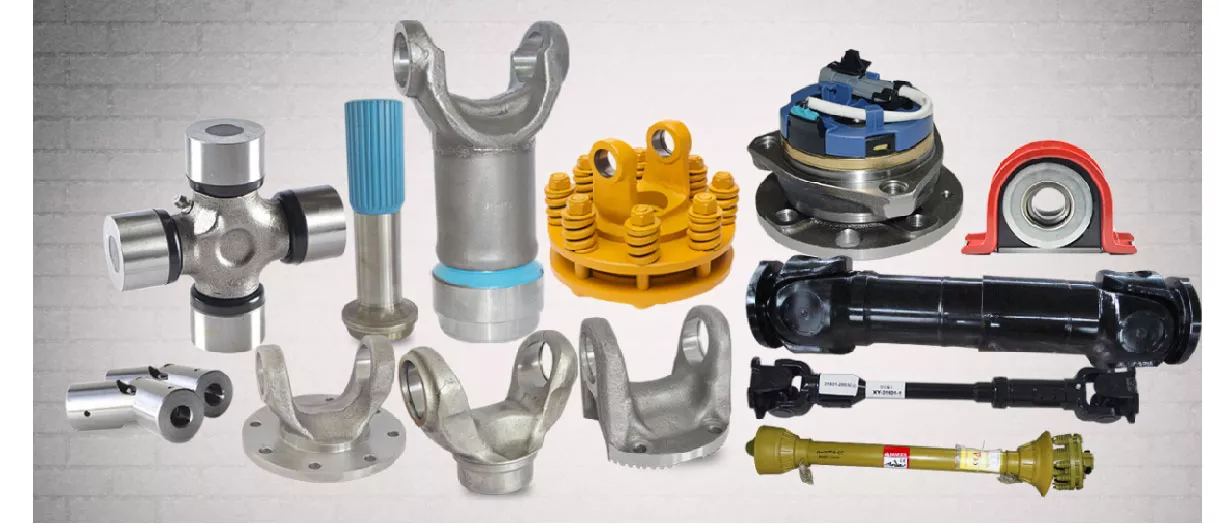
U-Joint Cross Kits
Complete kits with needle bearings, circlips, and zerk fittings. Forged steel, precise dimensioning.
Sintered Bronze Friction Discs
High thermal capacity replacement pads for slip clutches. Asbestos-free.
Safety Master Shields
UV-resistant conical shields and retention chains for WorkSafe compliance.
Sprockets & Drive Chains
Heavy-duty roller chains and hardened sprockets for side-drive rotary tillers.
Expert Knowledge Base: Top 10 Industry Inquiries
Manufacturing Power at Industrial Scale
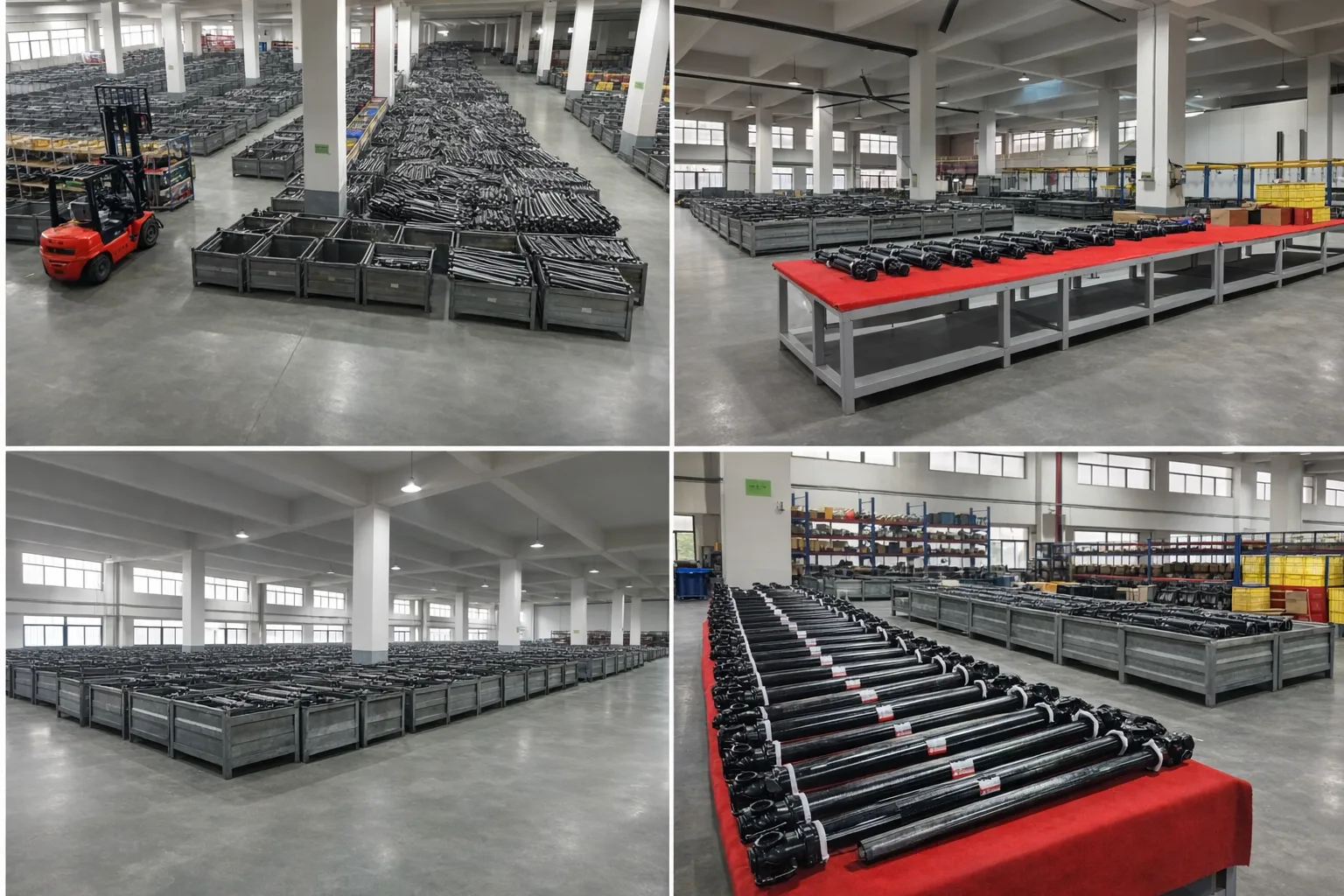
EVER-POWER is not just an assembler; we are a primary metallurgical manufacturer. Operating precision CNC machining centers, drop-forge hammers, and dynamic balancing rigs, our facility guarantees ISO 9001 certified quality control on every component. We do not just supply standard off-the-shelf drivelines; our engineering department welcomes blueprints, samples, and bespoke design requirements for heavy machinery manufacturers.
Global Shipping Logistics | Engineering Design Consultation | Custom Length Sizing