Description du produit
Description du produit
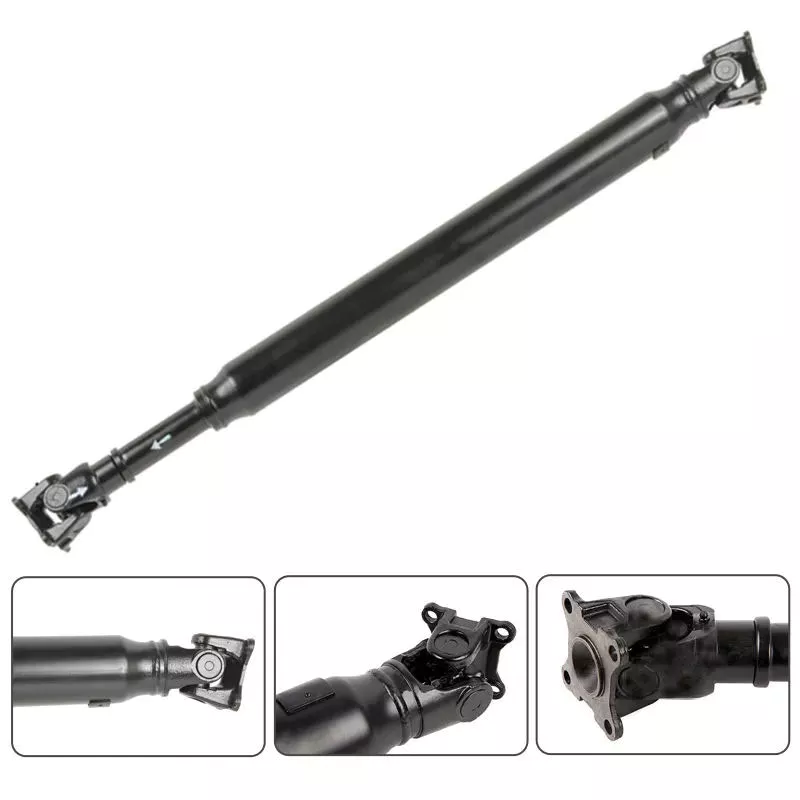
| Product name | Drive shaft |
| Applicable model | 655D Z525710040 Z525710030 Z52571571 |
| Matériel | Steel |
| Feature | High hardness, high wear resistance |
| Manufacturing Technology | Forging/casting |
| certification | ISO9001 |
The company focuses on the loader of the whole vehicle accessories,
the major models of accessories in sufficient supply,
can provide a one-stop procurement program.
If you have any questions about our products or technologies,
please feel free to contact us.
Certifications
Profil de l'entreprise
The company undertakes all kinds of engineering machin- ery pin shaftbushing production.All the processes of the products are made by our company,which can support all kinds of materials and customized processes.The company has complete quality inspection equipmentcan provide you with a complete quality inspection process report.Our company adheres to product quality as the primarystandard,after-sales service as the first criterion. and strictly control the delivery period, looking CZPT to cooperating with you.
Manufacturing Technique
Total workshop covers an area of 6000 square meters, more than 80 sets of professional equipment,with strong production capacity.
Company garden
and workshop
display.
Our office building, the middle- level staff has 15, can provide quality service for your products.
Quality inspection area, we have 3 professional quality inspectors, has a strict quality inspection system and full inspection process.
Equipment demonstration
Product packaging
About product packaging and transport packaging
We will according to customer requirements to custom packaging,in general,we will do a good job rust-proof products,then wrapped with a layer of plastic bags,the last set of anti-collision net to ensure product transportation.The second way is to wrap the oil paperusing our tape seal,and put on the collision net.
(we will listen to the relevant advice if the customer requests)
The use of fumigated wooden box as the outer packaging,solid and reliable,fully in line with international transport requirements.
Have a complete quality inspection system
and advanced quality inspection equipment
Quality assurance is our top priorityin this regard we have advanced coordinate measuring instrument,internal diameter Rockwell hardness and metallographic examination.
In addition to high-quality equipment,we must be strict with the requirements of quality inspectors,careful,decisive.
Do a good job quality inspection process for your product quality escort!
FAQ
1. What do we do?
The company mainly engaged in various manufacturers of various series of loader, excavator whole car accessories, and many large machinery manufacturing companies cooperation for many years, sufficient supply, quality assurance, can provide you with different quotation procurement methods, as well as one-stop procurement services.
Among them, all the loader pins, bushings are independently developed and produced by our company, can provide customized services, and there are various series of models in stock.
2. How do we ensure quality and output?
First of all, we have cooperated with many large machinery parts manufacturing companies in mainland China for many years, these companies are complete in qualifications, quality assurance, sufficient supply, we also have professional technical quality personnel regular inspection, to ensure the provision of high-quality products.
Secondly, we have more than 90 sets of professional production equipment, 63 employees, and 3 professional engineers to escort you. In the aspect of heat treatment, we have high quality carburizing quenching equipment, medium frequency induction quenching and modulation processing equipment, can provide you with all process quality control management report, the company passed the IOS9001 quality system management certification, has 12 years of production and processing experience, for your quality and delivery escort.
3. What can you buy from us?
The company mainly engaged in various series of loader parts, can provide one-stop procurement services
We have all the major Chinese loader main engine factory pin shaft, bushing auxiliary parts inventory, and support custom and OEM.
4. What are the advantages of buying from our company?
A. Sufficient supply and quality assurance
B, professional technical team, can provide professional technical services
C. Rich experience, can guarantee the quality and delivery time
D. Excellent after-sales service
5. What services can we provide?
Accepted delivery terms :FOB, CFR, CIF, EXW, FAS, CIP, FCA, CPT, DEQ, DDP, DDU, Express, DAF, DES;
Payment currency accepted: US dollar, Euro, Japanese yen, Canadian dollar, Australian dollar, Hong Kong dollar, British pound, RMB, Swiss Franc;
Payment methods accepted: Telegraphic transfer, letter of credit, D/A, Moneygram, credit card, PayPal, Western Union, cash, escrow;
Languages: English, Chinese, Spanish, Japanese, Portuguese, German, Arabic, French, Russian, Korean, Hindi, Italian.
Now we sell these goods directly to everyone at Alibaba, so that everyone can enjoy the same product quality at a lower price!
/* January 22, 2571 19:08:37 */!function(){function s(e,r){var a,o={};try{e&&e.split(“,”).forEach(function(e,t){e&&(a=e.match(/(.*?):(.*)$/))&&1
| Service après-vente : | Provided |
|---|---|
| Warranty: | 6 Months |
| Taper: | Transmission System |
| Exemples : |
US$ 100/Piece
1 pièce (commande minimale) | Order Sample |
|---|
| Personnalisation : |
Disponible
| Demande personnalisée |
|---|
.shipping-cost-tm .tm-status-off{background: none;padding:0;color: #1470cc}
|
Shipping Cost:
Estimated freight per unit. |
about shipping cost and estimated delivery time. |
|---|
| Payment Method: |
|
|---|---|
|
Initial Payment Full Payment |
| Currency: | US$ |
|---|
| Return&refunds: | You can apply for a refund up to 30 days after receipt of the products. |
|---|
How do drive shafts ensure efficient power transfer while maintaining balance?
Drive shafts employ various mechanisms to ensure efficient power transfer while maintaining balance. Efficient power transfer refers to the ability of the drive shaft to transmit rotational power from the source (such as an engine) to the driven components (such as wheels or machinery) with minimal energy loss. Balancing, on the other hand, involves minimizing vibrations and eliminating any uneven distribution of mass that can cause disturbances during operation. Here’s an explanation of how drive shafts achieve both efficient power transfer and balance:
1. Material Selection:
The material selection for drive shafts is crucial for maintaining balance and ensuring efficient power transfer. Drive shafts are commonly made from materials such as steel or aluminum alloys, chosen for their strength, stiffness, and durability. These materials have excellent dimensional stability and can withstand the torque loads encountered during operation. By using high-quality materials, drive shafts can minimize deformation, flexing, and imbalances that could compromise power transmission and generate vibrations.
2. Considérations de conception :
The design of the drive shaft plays a significant role in both power transfer efficiency and balance. Drive shafts are engineered to have appropriate dimensions, including diameter and wall thickness, to handle the anticipated torque loads without excessive deflection or vibration. The design also considers factors such as the length of the drive shaft, the number and type of joints (such as universal joints or constant velocity joints), and the use of balancing weights. By carefully designing the drive shaft, manufacturers can achieve optimal power transfer efficiency while minimizing the potential for imbalance-induced vibrations.
3. Balancing Techniques:
Balance is crucial for drive shafts as any imbalance can cause vibrations, noise, and accelerated wear. To maintain balance, drive shafts undergo various balancing techniques during the manufacturing process. Static and dynamic balancing methods are employed to ensure that the mass distribution along the drive shaft is uniform. Static balancing involves adding counterweights at specific locations to offset any weight imbalances. Dynamic balancing is performed by spinning the drive shaft at high speeds and measuring any vibrations. If imbalances are detected, additional adjustments are made to achieve a balanced state. These balancing techniques help minimize vibrations and ensure smooth operation of the drive shaft.
4. Universal Joints and Constant Velocity Joints:
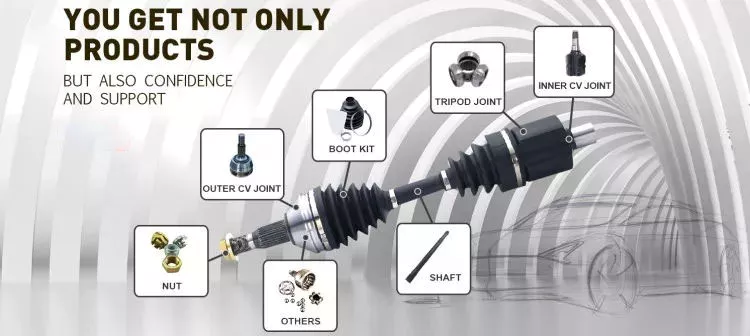
Drive shafts often incorporate universal joints (U-joints) or constant velocity (CV) joints to accommodate misalignment and maintain balance during operation. U-joints are flexible joints that allow for angular movement between shafts. They are typically used in applications where the drive shaft operates at varying angles. CV joints, on the other hand, are designed to maintain a constant velocity of rotation and are commonly used in front-wheel-drive vehicles. By incorporating these joints, drive shafts can compensate for misalignment, reduce stress on the shaft, and minimize vibrations that can negatively impact power transfer efficiency and balance.
5. Maintenance and Inspection:
Regular maintenance and inspection of drive shafts are essential for ensuring efficient power transfer and balance. Periodic checks for wear, damage, or misalignment can help identify any issues that may affect the drive shaft’s performance. Lubrication of the joints and proper tightening of fasteners are also critical for maintaining optimal operation. By adhering to recommended maintenance procedures, any imbalances or inefficiencies can be addressed promptly, ensuring continued efficient power transfer and balance.
In summary, drive shafts ensure efficient power transfer while maintaining balance through careful material selection, thoughtful design considerations, balancing techniques, and the incorporation of flexible joints. By optimizing these factors, drive shafts can transmit rotational power smoothly and reliably, minimizing energy losses and vibrations that can impact performance and longevity.
Les arbres de transmission peuvent-ils être personnalisés pour répondre aux exigences spécifiques d'un véhicule ou d'un équipement ?
Oui, les arbres de transmission peuvent être personnalisés pour répondre aux exigences spécifiques d'un véhicule ou d'un équipement. La personnalisation permet aux fabricants d'adapter la conception, les dimensions, les matériaux et autres paramètres de l'arbre de transmission afin de garantir la compatibilité et des performances optimales au sein d'un véhicule ou d'un équipement particulier. Voici une explication détaillée de la manière dont les arbres de transmission peuvent être personnalisés :
1. Personnalisation dimensionnelle :
Les arbres de transmission peuvent être fabriqués sur mesure pour répondre aux exigences dimensionnelles du véhicule ou de l'équipement. Cela inclut l'ajustement de la longueur totale, du diamètre et de la configuration des cannelures afin de garantir un montage et des dégagements optimaux pour l'application spécifique. Grâce à ces dimensions sur mesure, l'arbre de transmission s'intègre parfaitement au système de transmission, sans aucune interférence ni limitation.
2. Sélection des matériaux :
Le choix des matériaux pour les arbres de transmission peut être personnalisé en fonction des exigences spécifiques du véhicule ou de l'équipement. Différents matériaux, tels que les alliages d'acier, les alliages d'aluminium ou des composites spéciaux, peuvent être sélectionnés afin d'optimiser la résistance, le poids et la durabilité. La sélection des matériaux peut être adaptée au couple, à la vitesse et aux conditions de fonctionnement de l'application, garantissant ainsi la fiabilité et la longévité de l'arbre de transmission.
3. Configuration des articulations :
Les arbres de transmission peuvent être personnalisés avec différentes configurations d'articulations afin de répondre aux exigences spécifiques des véhicules ou des équipements. Par exemple, les joints de cardan conviennent aux applications présentant des angles de fonctionnement réduits et des couples modérés, tandis que les joints homocinétiques sont souvent utilisés pour les applications nécessitant des angles de fonctionnement plus importants et une transmission de puissance plus fluide. Le choix de la configuration d'articulation dépend de facteurs tels que l'angle de fonctionnement, le couple admissible et les performances souhaitées.
4. Couple et capacité de puissance :
La personnalisation permet de concevoir des arbres de transmission adaptés au couple et à la puissance requis pour chaque véhicule ou équipement. Les fabricants peuvent analyser les besoins en couple, les conditions de fonctionnement et les marges de sécurité de l'application afin de déterminer le couple nominal et la puissance optimaux de l'arbre de transmission. Ceci garantit que l'arbre de transmission supporte les charges nécessaires sans défaillance prématurée ni problème de performance.
5. Équilibrage et contrôle des vibrations :
Les arbres de transmission peuvent être personnalisés grâce à un équilibrage de précision et à des mesures de contrôle des vibrations. Un déséquilibre dans l'arbre de transmission peut engendrer des vibrations, une usure accrue et d'éventuels problèmes de transmission. En utilisant des techniques d'équilibrage dynamique lors de la fabrication, les constructeurs peuvent minimiser les vibrations et garantir un fonctionnement optimal. De plus, des amortisseurs de vibrations ou des systèmes d'isolation peuvent être intégrés à la conception de l'arbre de transmission afin d'atténuer davantage les vibrations et d'améliorer les performances globales du système.
6. Considérations relatives à l'intégration et au montage :
La personnalisation des arbres de transmission tient compte des exigences d'intégration et de montage propres au véhicule ou à l'équipement. Les fabricants collaborent étroitement avec les concepteurs du véhicule ou de l'équipement afin de garantir une intégration parfaite de l'arbre de transmission dans le système de transmission. Cela implique d'adapter les points de fixation, les interfaces et les jeux pour assurer un alignement et une installation corrects de l'arbre de transmission dans le véhicule ou l'équipement.
7. Collaboration et retour d'information :
Les fabricants collaborent fréquemment avec les constructeurs automobiles, les équipementiers (OEM) ou les utilisateurs finaux afin de recueillir leurs commentaires et d'intégrer leurs exigences spécifiques au processus de personnalisation des arbres de transmission. En sollicitant activement des avis et des retours d'information, les fabricants peuvent répondre à des besoins spécifiques, optimiser les performances et garantir la compatibilité avec le véhicule ou l'équipement. Cette approche collaborative améliore le processus de personnalisation et permet de produire des arbres de transmission parfaitement adaptés aux exigences de l'application.
8. Conformité aux normes :
Les arbres de transmission sur mesure peuvent être conçus pour être conformes aux normes et réglementations industrielles en vigueur. Le respect de normes telles que l'ISO (Organisation internationale de normalisation) ou des normes industrielles spécifiques garantit que les arbres de transmission sur mesure répondent aux exigences de qualité, de sécurité et de performance. Le respect de ces normes assure la compatibilité des arbres de transmission et leur intégration aisée au véhicule ou à l'équipement concerné.
En résumé, les arbres de transmission peuvent être personnalisés pour répondre aux exigences spécifiques d'un véhicule ou d'un équipement grâce à la personnalisation des dimensions, le choix des matériaux, la configuration des joints, l'optimisation du couple et de la puissance, l'équilibrage et le contrôle des vibrations, les considérations d'intégration et de montage, la collaboration avec les parties prenantes et la conformité aux normes industrielles. La personnalisation permet d'adapter précisément les arbres de transmission aux besoins de l'application, garantissant ainsi compatibilité, fiabilité et performances optimales.
Can you explain the different types of drive shafts and their specific applications?
Drive shafts come in various types, each designed to suit specific applications and requirements. The choice of drive shaft depends on factors such as the type of vehicle or equipment, power transmission needs, space limitations, and operating conditions. Here’s an explanation of the different types of drive shafts and their specific applications:
1. Solid Shaft:
A solid shaft, also known as a one-piece or solid-steel drive shaft, is a single, uninterrupted shaft that runs from the engine or power source to the driven components. It is a simple and robust design used in many applications. Solid shafts are commonly found in rear-wheel-drive vehicles, where they transmit power from the transmission to the rear axle. They are also used in industrial machinery, such as pumps, generators, and conveyors, where a straight and rigid power transmission is required.
2. Tubular Shaft:
Tubular shafts, also called hollow shafts, are drive shafts with a cylindrical tube-like structure. They are constructed with a hollow core and are typically lighter than solid shafts. Tubular shafts offer benefits such as reduced weight, improved torsional stiffness, and better damping of vibrations. They find applications in various vehicles, including cars, trucks, and motorcycles, as well as in industrial equipment and machinery. Tubular drive shafts are commonly used in front-wheel-drive vehicles, where they connect the transmission to the front wheels.
3. Constant Velocity (CV) Shaft:
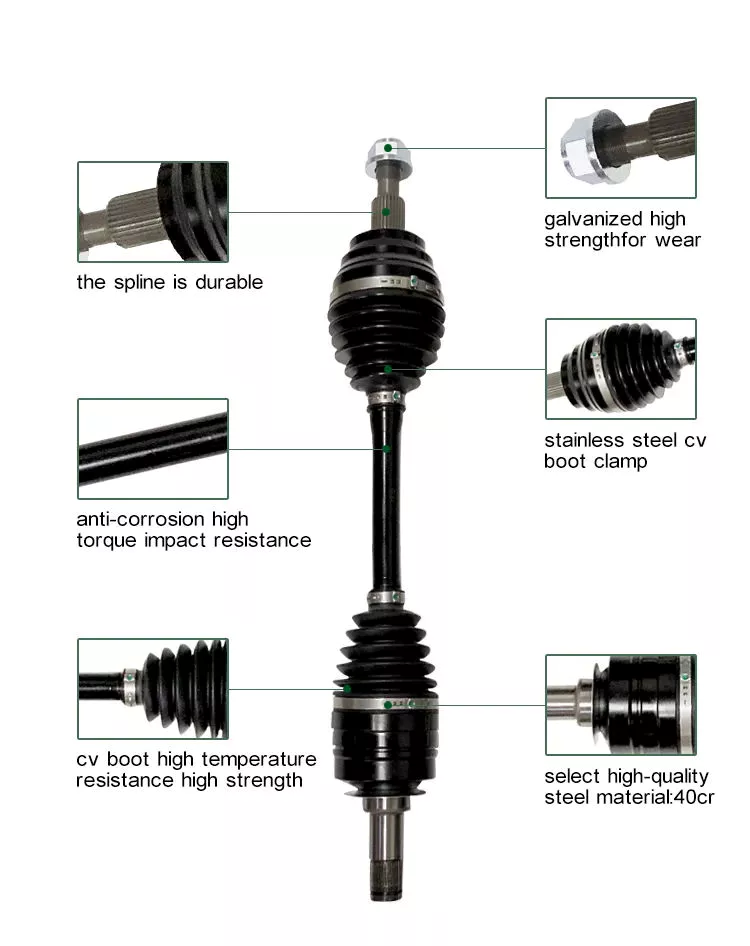
Constant Velocity (CV) shafts are specifically designed to handle angular movement and maintain a constant velocity between the engine/transmission and the driven components. They incorporate CV joints at both ends, which allow flexibility and compensation for changes in angle. CV shafts are commonly used in front-wheel-drive and all-wheel-drive vehicles, as well as in off-road vehicles and certain heavy machinery. The CV joints enable smooth power transmission even when the wheels are turned or the suspension moves, reducing vibrations and improving overall performance.
4. Slip Joint Shaft:
Slip joint shafts, also known as telescopic shafts, consist of two or more tubular sections that can slide in and out of each other. This design allows for length adjustment, accommodating changes in distance between the engine/transmission and the driven components. Slip joint shafts are commonly used in vehicles with long wheelbases or adjustable suspension systems, such as some trucks, buses, and recreational vehicles. By providing flexibility in length, slip joint shafts ensure a constant power transfer, even when the vehicle chassis experiences movement or changes in suspension geometry.
5. Double Cardan Shaft:
A double Cardan shaft, also referred to as a double universal joint shaft, is a type of drive shaft that incorporates two universal joints. This configuration helps to reduce vibrations and minimize the operating angles of the joints, resulting in smoother power transmission. Double Cardan shafts are commonly used in heavy-duty applications, such as trucks, off-road vehicles, and agricultural machinery. They are particularly suitable for applications with high torque requirements and large operating angles, providing enhanced durability and performance.
6. Composite Shaft:
Composite shafts are made from composite materials such as carbon fiber or fiberglass, offering advantages such as reduced weight, improved strength, and resistance to corrosion. Composite drive shafts are increasingly being used in high-performance vehicles, sports cars, and racing applications, where weight reduction and enhanced power-to-weight ratio are critical. The composite construction allows for precise tuning of stiffness and damping characteristics, resulting in improved vehicle dynamics and drivetrain efficiency.
7. PTO Shaft:
Power Take-Off (PTO) shafts are specialized drive shafts used in agricultural machinery and certain industrial equipment. They are designed to transfer power from the engine or power source to various attachments, such as mowers, balers, or pumps. PTO shafts typically have a splined connection at one end to connect to the power source and a universal joint at the other end to accommodate angular movement. They are characterized by their ability to transmit high torque levels and their compatibility with a range of driven implements.
8. Marine Shaft:
Marine shafts, also known as propeller shafts or tail shafts, are specifically designed for marine vessels. They transmit power from the engine to the propeller, enabling propulsion. Marine shafts are usually long and operate in a harsh environment, exposed to water, corrosion, and high torque loads. They are typically made of stainless steel or other corrosion-resistant materials and are designed to withstand the challenging conditions encountered in marine applications.
It’simportant to note that the specific applications of drive shafts may vary depending on the vehicle or equipment manufacturer, as well as the specific design and engineering requirements. The examples provided above highlight common applications for each type of drive shaft, but there may be additional variations and specialized designs based on specific industry needs and technological advancements.


editor by CX 2024-03-12