
Produktbeschreibung
Customized Power transmission Agricultural Transmission Machine PTO Shaft
1. Rohre oder Leitungen
Wir haben bereits dreieckige und zitronenförmige Profilrohre für alle von uns angebotenen Serien.
Wir führen außerdem Sternrohre, Keilwellenrohre und andere Profilrohre, die von unseren Kunden (für bestimmte Serien) benötigt werden. (Bitte beachten Sie, dass unser Katalog nicht alle von uns hergestellten Artikel enthält.)
Falls Sie andere Röhrenformen als dreieckig oder zitronenförmig wünschen, senden Sie uns bitte Zeichnungen oder Bilder.
2. Endjoche
Wir haben verschiedene Arten von Schnellkupplungsjochen und Jochen mit glatter Bohrung. Ich nenne Ihnen zur Veranschaulichung den gängigsten Typ.
Sie können uns auch Zeichnungen oder Bilder zusenden, falls Sie den gewünschten Artikel nicht in unserem Katalog finden.
3. Sicherheitsvorrichtungen oder Kupplungen
Ich füge die Details der Sicherheitsvorrichtungen zur Information bei. Wir haben bereits Freilauf (RA), Ratschendrehmomentbegrenzer (SA), Scherbolzendrehmomentbegrenzer (SB), 3 Arten von Reibungsdrehmomentbegrenzern (FF, FFS, FCS) und Überholkupplungen (Adapter) (FAS).
4. Sollten Sie weitere spezielle Anforderungen bezüglich Kunststoffschutz, Verbindungsmethode, Lackfarbe, Verpackung usw. haben, teilen Sie mir diese bitte mit.
Merkmale:
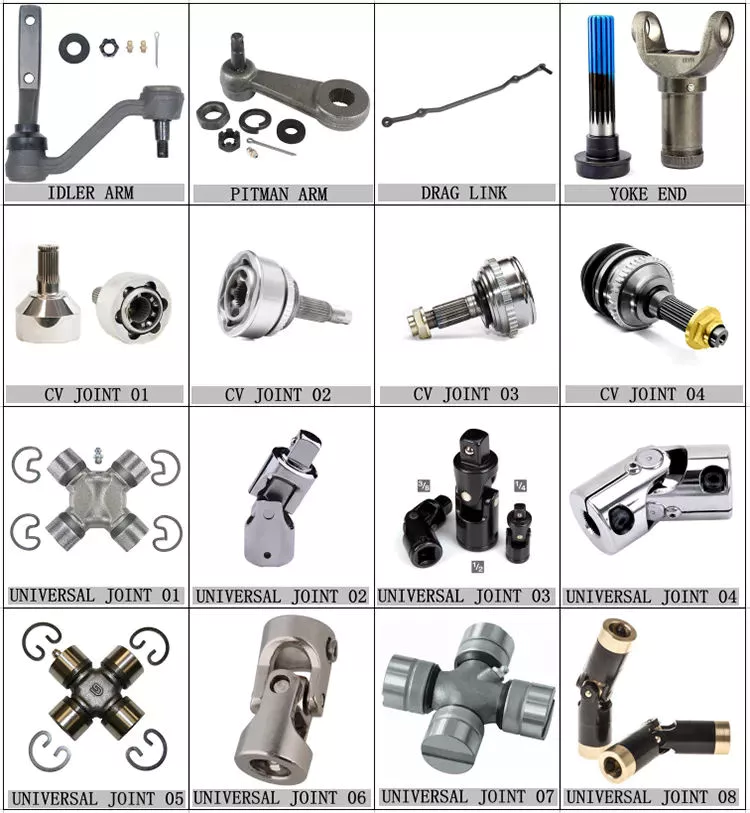
1. Wir sind seit Jahren auf die Entwicklung und Herstellung von Antriebswellen, Lenkkupplungswellen und Kreuzgelenken spezialisiert und exportieren diese in die USA, nach Europa, Australien usw.
2. Anwendung auf alle Arten von allgemeinen mechanischen Situationen
3. Unsere Produkte zeichnen sich durch hohe Festigkeit und Steifigkeit aus.
4. Hitzebeständig und säurebeständig
5. OEM-Aufträge sind willkommen.
Unser Werk ist ein führender Hersteller von Zapfwellenjochs und Kreuzgelenken.
Wir fertigen hochwertige Zapfwellenjoche für diverse Fahrzeuge, Baumaschinen und -geräte. Alle Produkte sind mit einem drehbaren Leichtmetallgehäuse ausgestattet.
/* 22. Januar 2571 19:08:37 */!function(){function s(e,r){var a,o={};try{e&&e.split(“,”).forEach(function(e,t){e&&(a=e.match(/(.*?):(.*)$/))&&1
| Typ: | Gabel |
|---|---|
| Verwendung: | Verarbeitung landwirtschaftlicher Produkte, Infrastruktur für landwirtschaftliche Flächen, Bodenbearbeitung, Erntemaschinen, Aussaat und Düngung, Getreidedreschen, Reinigung und Trocknung |
| Material: | Kohlenstoffstahl |
| Stromquelle: | Zapfwellenrohr |
| Weight: | Different Weight |
| Transportpaket: | Standard-Seetüchtigkeitspaket |
| Proben: |
US$ 100/Piece
1 Stück (Mindestbestellmenge) | |
|---|
| Anpassung: |
Verfügbar
| Kundenspezifische Anfrage |
|---|
Can PTO shafts be adapted for use in both agricultural and industrial settings?
Yes, PTO (Power Take-Off) shafts can be adapted for use in both agricultural and industrial settings. While PTO shafts are commonly associated with agricultural machinery, they are versatile components that can be utilized in various applications beyond the agricultural sector. With appropriate modifications and considerations, PTO shafts can effectively transfer power in industrial settings as well. Here’s a detailed explanation of how PTO shafts can be adapted for both agricultural and industrial use:
1. Standard PTO Shaft Design: PTO shafts have a standardized design that allows for compatibility and interchangeability across different equipment and machinery. This standardization enables PTO shafts to be used in various applications, including both agricultural and industrial settings. The basic components of a PTO shaft, such as the universal joints, splined shafts, and protective guards, remain consistent, regardless of the specific application. This consistency allows for easy adaptation and integration into different machinery and equipment.
2. Shaft Length and Sizing: PTO shafts can be customized in terms of length and sizing to suit specific requirements in both agricultural and industrial settings. The length of the shaft can be adjusted to accommodate different distances between the power source and the driven machinery. This flexibility allows for optimal power transmission and ensures compatibility with various equipment setups. Similarly, the sizing of the PTO shaft, including the diameter and splined shaft specifications, can be tailored to meet the torque and power requirements of different applications, whether in agriculture or industry.
3. Power Requirements: PTO shafts are designed to transfer power from a power source to driven machinery. In agricultural settings, the power source is typically a tractor or other agricultural vehicles, while in industrial settings, it can be an engine, motor, or power unit specific to the industry. PTO shafts can be adapted to handle different power requirements by considering factors such as torque capacity, rotational speed, and the specific demands of the machinery or equipment being driven. By selecting the appropriate PTO shaft based on the power requirements, the shaft can effectively transfer power in both agricultural and industrial applications.
4. Sicherheitsaspekte: Safety is a critical aspect of PTO shaft design and usage, regardless of the application. PTO shafts incorporate safety features such as protective guards and shields to prevent accidental contact with rotating components. These safety measures are essential in agricultural and industrial settings to minimize the risk of entanglement, injury, or damage. Adapting PTO shafts for industrial use may require additional safety considerations based on the specific hazards present in industrial environments. However, the core safety principles and features of PTO shafts can be applied and adapted to ensure safe operation in both settings.
5. Specialized Attachments: PTO shafts can be equipped with specialized attachments or adapters to accommodate different driven machinery or equipment. In agricultural settings, PTO shafts commonly connect to implements such as mowers, balers, or sprayers. In industrial settings, PTO shafts may be adapted to connect to various industrial machinery, including pumps, generators, compressors, or conveyors. These specialized attachments ensure compatibility and efficient power transfer between the PTO shaft and the driven equipment, allowing for seamless integration in both agricultural and industrial applications.
6. Umweltaspekte: PTO shafts can be adapted to address specific environmental conditions in both agricultural and industrial settings. For example, in agricultural applications, PTO shafts may need to withstand exposure to dirt, dust, moisture, and varying weather conditions. Industrial settings may have their unique environmental challenges, such as exposure to chemicals, high temperatures, or abrasive materials. By selecting PTO shaft materials, protective coatings, and seals suitable for the specific environment, the shafts can be adapted to ensure reliable and durable performance in various settings.
7. Einhaltung von Standards: PTO shafts, whether used in agricultural or industrial settings, need to comply with relevant safety standards and regulations. Manufacturers adhere to guidelines and requirements set by organizations such as the American Society of Agricultural and Biological Engineers (ASABE) or other regional safety authorities. Compliance ensures that PTO shafts meet safety criteria and performance standards applicable to both agricultural and industrial environments. Users can rely on standardized PTO shafts that have undergone testing and certification, offering assurance regarding their reliability and safety.
By considering the factors mentioned above, PTO shafts can be adapted to effectively transfer power in both agricultural and industrial settings. The versatile nature of PTO shafts, coupled with customization options, safety considerations, specialized attachments, and compliance with standards, allows for their successful integration into a wide range of machinery and equipment across various industries.

Welchen Beitrag leisten Zapfwellen zur Effizienz landwirtschaftlicher Betriebe?
Zapfwellen spielen eine entscheidende Rolle bei der Steigerung der Effizienz landwirtschaftlicher Betriebe, indem sie eine vielseitige und zuverlässige Antriebsquelle für verschiedene Landmaschinen bereitstellen. Zapfwellen ermöglichen es landwirtschaftlichen Maschinen, Kraft von Traktoren oder anderen Antriebsmaschinen zu beziehen und so die Energie effizient für eine Vielzahl von Aufgaben zu nutzen. Im Folgenden finden Sie eine detaillierte Erklärung, wie Zapfwellen zur Effizienz landwirtschaftlicher Betriebe beitragen:
1. Vielseitigkeit: Zapfwellen bieten vielseitige Einsatzmöglichkeiten, da sie den Anschluss verschiedener Anbaugeräte und Maschinen an Traktoren oder andere Antriebsquellen ermöglichen. Landwirte können so mit einer einzigen Antriebseinheit, wie beispielsweise einem Traktor, mehrere landwirtschaftliche Geräte betreiben, darunter Mähwerke, Ballenpressen, Bodenfräsen, Sämaschinen, Spritzen und vieles mehr. Der schnelle Wechsel zwischen verschiedenen Anbaugeräten mithilfe einer Zapfwelle minimiert Ausfallzeiten und maximiert die Effizienz in der Landwirtschaft.
2. Energieübertragung: Zapfwellen übertragen die Kraft des Traktormotors effizient auf die landwirtschaftlichen Anbaugeräte. Die vom Motor erzeugte Rotationsenergie wird über die Zapfwelle auf die angeschlossenen Maschinen übertragen. Diese direkte Kraftübertragung macht separate Motoren an jedem Anbaugerät überflüssig und reduziert so Kosten und Wartungsaufwand. Zapfwellen gewährleisten eine zuverlässige Stromversorgung und ermöglichen so effiziente und effektive landwirtschaftliche Arbeiten.
3. Gesteigerte Produktivität: Durch den Einsatz von Zapfwellen lassen sich landwirtschaftliche Arbeiten schneller und effizienter als manuell oder mit anderen Antriebsmethoden durchführen. Zapfwellengetriebene Maschinen arbeiten in der Regel schneller und leistungsstärker als von Menschen bediente oder manuelle Geräte. Diese gesteigerte Produktivität ermöglicht es Landwirten, Aufgaben wie Pflügen, Säen, Ernten und Materialtransport effizienter zu erledigen, den Arbeitsaufwand zu reduzieren und die Gesamtproduktivität des Betriebs zu erhöhen.
4. Zeitersparnis: Zapfwellen tragen wesentlich zur Zeitersparnis in der Landwirtschaft bei. Durch das schnelle An- und Abkoppeln von Anbaugeräten mithilfe standardisierter Zapfwellen können Landwirte zügig zwischen verschiedenen Arbeitsgängen wechseln. Dies spart Zeit beim Einrichten der Maschinen sowie beim Wechsel zwischen verschiedenen Arbeitsgängen auf dem Feld. Diese Zeiteffizienz ist besonders in kritischen Anbauphasen wie Aussaat oder Ernte von großem Wert, da hier ein präziser Arbeitsablauf entscheidend für optimale Erträge und Qualität ist.
5. Reduzierter manueller Arbeitsaufwand: Zapfwellen minimieren den Bedarf an Handarbeit bei anstrengenden oder sich wiederholenden Aufgaben. Durch die Nutzung der Kraft von Traktoren oder anderen Antriebsmaschinen können Landwirte verschiedene Arbeitsgänge mechanisieren, die sonst erhebliche körperliche Anstrengung erfordern würden. Landwirtschaftliche Geräte, die von Zapfwellen angetrieben werden, können Aufgaben wie Pflügen, Mähen und Ballenpressen mit minimalem menschlichen Eingriff erledigen, wodurch die Arbeitskosten gesenkt und die Gesamteffizienz gesteigert werden.
6. Präzision und Konsistenz: Zapfwellen tragen zu Präzision und Gleichmäßigkeit in der Landwirtschaft bei. Die konstante Kraftübertragung von der Zapfwelle gewährleistet einen gleichmäßigen Betrieb und eine gleichbleibende Leistung der angeschlossenen Maschinen. Dies ermöglicht eine gleichmäßige Saatgutablage, eine gleichmäßige Ausbringung von Düngemitteln oder Pflanzenschutzmitteln sowie ein präzises Schneiden oder Ernten der Feldfrüchte. Präzision und Gleichmäßigkeit führen zu verbesserter Erntequalität, höheren Erträgen und weniger Abfall und tragen letztendlich zur Gesamteffizienz der landwirtschaftlichen Betriebe bei.
7. Anpassungsfähigkeit an unterschiedliches Gelände: Zapfwellengetriebene Maschinen sind äußerst anpassungsfähig an die unterschiedlichsten Geländearten in der Landwirtschaft. Traktoren mit Zapfwelle können unebenes oder schwieriges Gelände bewältigen und ermöglichen so den effektiven Einsatz von Anbaugeräten an Hängen, auf unbefestigten Feldern oder in hügeligem Gelände. Diese Anpassungsfähigkeit gewährleistet Landwirten eine effiziente Bewirtschaftung ihrer Flächen unabhängig von topografischen Gegebenheiten und steigert dadurch die Betriebseffizienz und Produktivität.
8. Integration mit Automatisierung und Technologie: Zapfwellen lassen sich in moderne landwirtschaftliche Betriebe integrieren und mit Automatisierungs- und Technologiefortschritten verbinden. Automatisierungssysteme wie Präzisionslenkung und -steuerung können mit zapfwellengetriebenen Maschinen synchronisiert werden, um den Betrieb zu optimieren und Abfall zu minimieren. Fortschritte bei der Datenerfassung und -analyse ermöglichen es Landwirten zudem, Maschinenleistung, Kraftstoffverbrauch und Produktivität zu überwachen und zu optimieren und so die Effizienz landwirtschaftlicher Betriebe weiter zu steigern.
Durch ihre Vielseitigkeit, effiziente Kraftübertragung, gesteigerte Produktivität, Zeitersparnis, reduzierten manuellen Arbeitsaufwand, Präzision, Geländeanpassungsfähigkeit und die Integration in Automatisierungs- und Technologiesysteme tragen Zapfwellen maßgeblich zur Effizienzsteigerung landwirtschaftlicher Betriebe bei. Sie ermöglichen Landwirten die mühelose Ausführung einer Vielzahl von Aufgaben und verbessern so letztendlich die Produktivität, senken die Kosten und unterstützen nachhaltige Anbaumethoden.
Which industries commonly use PTO shafts for power transmission?
PTO shafts (Power Take-Off shafts) are widely used in various industries where power transmission is required to drive machinery and equipment. Their versatility, efficiency, and compatibility with different types of machinery make them valuable components in several sectors. Here’s a detailed explanation of the industries that commonly use PTO shafts for power transmission:
1. Agriculture: The agricultural industry extensively relies on PTO shafts for power transmission. Tractors equipped with PTOs are commonly used to drive a wide range of agricultural implements and machinery. PTO-driven equipment includes mowers, balers, tillers, seeders, sprayers, grain augers, harvesters, and many more. PTO shafts allow for the efficient transfer of power from the tractor’s engine to these implements, enabling various agricultural operations such as cutting, baling, tilling, planting, spraying, and harvesting. The agricultural sector heavily depends on PTO shafts to enhance productivity and streamline farming processes.
2. Construction and Earthmoving: In the construction and earthmoving industry, PTO shafts find applications in machinery used for excavation, grading, and material handling. PTO-driven equipment such as backhoes, loaders, excavators, trenchers, and stump grinders utilize PTO shafts to transfer power from the prime movers, typically hydraulic systems, to drive the necessary attachments. These attachments require the high torque and power provided by PTO shafts to perform tasks like digging, loading, trenching, and grinding. PTO shafts allow for versatile and efficient power transmission in construction and earthmoving operations.
3. Forestry: The forestry industry utilizes PTO shafts for power transmission in various logging and timber processing equipment. PTO-driven machinery such as wood chippers, sawmills, log splitters, and debarkers rely on PTO shafts to transfer power from tractors or dedicated power units to perform tasks like chipping, sawing, splitting, and debarking wood. PTO shafts provide the necessary power and torque to drive the cutting and processing mechanisms, enabling efficient and productive forestry operations.
4. Landscaping and Groundskeeping: PTO shafts play a crucial role in the landscaping and groundskeeping industry. Equipment like lawn mowers, rotary cutters, flail mowers, and aerators utilize PTO shafts to transfer power from tractors or dedicated power units to drive the cutting or grooming mechanisms. PTO shafts enable efficient power transmission, allowing operators to maintain lawns, parks, golf courses, and other outdoor spaces with precision and productivity.
5. Mining and Quarrying: PTO shafts have applications in the mining and quarrying industry, particularly in equipment used for material extraction, crushing, and screening. PTO-driven machinery such as crushers, screeners, and conveyors rely on PTO shafts to transfer power from engines or motors to drive the crushing and screening mechanisms, as well as the material handling systems. PTO shafts provide the necessary power and torque to process and transport bulk materials effectively in mining and quarrying operations.
6. Industrial Manufacturing: PTO shafts are utilized in various industrial manufacturing processes that require power transmission to drive specific machinery and equipment. Industries such as food processing, textile manufacturing, paper production, and chemical processing may use PTO-driven machinery for tasks like mixing, blending, cutting, extruding, and conveying. PTO shafts enable efficient power transfer to these machines, ensuring smooth and reliable operation in industrial manufacturing settings.
7. Utilities and Infrastructure Maintenance: PTO shafts find applications in utilities and infrastructure maintenance operations. Equipment like street sweepers, sewer cleaners, road maintenance machines, and drain augers utilize PTO shafts to transfer power from trucks or dedicated power units to perform tasks like sweeping, cleaning, and maintenance of roads, sewers, and other public infrastructure. PTO shafts enable efficient power transmission, ensuring effective and reliable operation of these utility and maintenance machines.
8. Others: PTO shafts are also used in several other industries and sectors where power transmission is required. This includes applications in the transportation industry for powering refrigeration units, fuel pumps, and hydraulic systems in trucks and trailers. PTO shafts also find applications in the marine industry for powering winches, pumps, and other equipment on boats and ships.
In summary, PTO shafts are commonly used in a wide range of industries for power transmission. These industries include agriculture, construction and earthmoving, forestry, landscaping and groundskeeping, mining and quarrying, industrial manufacturing, utilities and infrastructure maintenance, transportation, and marine sectors. PTO shafts play a critical rolein enhancing productivity, enabling efficient operation of machinery, and facilitating various tasks in these industries.

editor by CX 2024-04-16

























